- 54
- Attacks
- 66
- Doors
- 2001–2025
- Years
- 2025
- Version
More data
Two datasets built from the Active Attack Data: the doors attackers met in K-12 school attacks, and the officers shot in active shooter incidents.
Each comes as CSV files with a PDF codebook, in the same form as the Active Attack Data. Jump to K-12 door security or Officers shot.
K-12 door security
U.S. K-12 active shooter attacks and the doors the attackers came up against: whether each door was locked, barricaded or breached, and how the attacker got through.
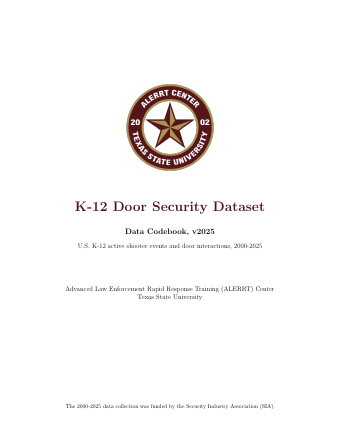
Two CSV files and a PDF codebook
The codebook describes every variable in both files: what it records, its values, and how often it is missing.
Two files
The events file has one row per attack (54 rows, 69 variables): school, timing, victims by location, attackers, firearms and the response. The doors file has one row per door (66 doors in 22 attacks, 26 variables).
Linking them
The files share one column, case_number. To look at doors by an event characteristic, such as school level, join the events file to the doors file on case_number.
Doors
Each door is recorded as coded and grouped as in the 2026 report: lock type, status (locked, unlocked, propped), breach attempts, barricades, whether the attacker got through, and by what route.
Funding and report
Collection of the 2001–2025 data was funded by the Security Industry Association and first reported in ALERRT’s The Role of Locked Doors and Access Control in School-Based Active Shooter Events (2026). Where this version differs from the report, this version is the corrected one.
Suggested citation
Advanced Law Enforcement Rapid Response Training (ALERRT) Center. (2026). K-12 Door Security Dataset (Version 2025) [Data set]. Texas State University. https://activeattackdata.org/datasets.html#k-12-door-security
For the 2001–2025 findings, please also cite the 2026 report.
BibTeX
@misc{alerrt_k12_door_security_2025,
  author       = {{Advanced Law Enforcement Rapid Response Training (ALERRT) Center}},
  title        = {K-12 Door Security Dataset},
  year         = {2026},
  version      = {2025},
  publisher    = {Texas State University},
  howpublished = {\url{https://activeattackdata.org/datasets.html#k-12-door-security}},
  note         = {Data set}
}
Officers shot
Law enforcement officers struck by gunfire during active shooter incidents: where they were, how they were hit, and what they were doing at the time.
- 156
- Officers
- 75
- Incidents
- 35
- Killed
- 2001–2025
- Years
- 2025
- Version
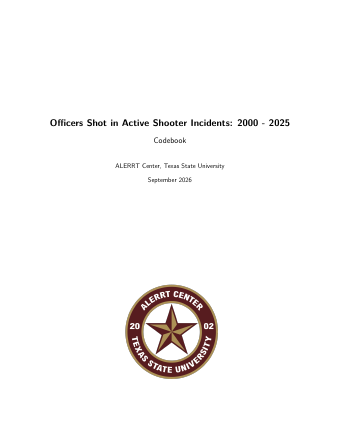
A CSV file and a PDF codebook
The codebook describes every variable, the rules for who counts as shot, and the sources behind the coding.
One row per officer
156 officers in 75 incidents, 42 variables. Officers shot in the same incident share a case_id; incident-level columns repeat on each officer’s row.
Who counts as shot
An officer is included when struck by gunfire: wounds and grazes, rounds stopped by body armor or equipment, bullet fragments and ricochets, and fire from other officers (blue_on_blue). Injuries only from glass or debris are not counted. The codebook gives the full rules.
Linked to the Active Attack Data
aad_case_code matches case_code in the Active Attack Data, so incident details (location, attacker, casualties) can be joined in. Officer details come from news and agency reports, prosecutor and court records, and FBI LEOKA.
Reading the file
Read officer_id as text: officer 30.10 is not 30.1, and spreadsheet programs will merge them. Officers are named where their names were released; attackers are never named, and the notes say “the attacker” instead.
Suggested citation
Advanced Law Enforcement Rapid Response Training (ALERRT) Center. (2026). Officers Shot in Active Shooter Incidents (Version 2025) [Data set]. Texas State University. https://activeattackdata.org/datasets.html#officers-shot
BibTeX
@misc{alerrt_officers_shot_2025,
  author       = {{Advanced Law Enforcement Rapid Response Training (ALERRT) Center}},
  title        = {Officers Shot in Active Shooter Incidents},
  year         = {2026},
  version      = {2025},
  publisher    = {Texas State University},
  howpublished = {\url{https://activeattackdata.org/datasets.html#officers-shot}},
  note         = {Data set}
}
Questions about either dataset, or a value that looks wrong: Contact.